GAME PROTOTYPING
Playable game prototypes, before you write a line of code.
Paste your studio's website or a game page. Vidscape learns your catalogue and art style, interviews you about where you want to go next, then pitches new game concepts — each one turned into a real design document, a generated art kit, a polished visual mock and, when you're ready, a prototype you can actually play in the browser.
- New concepts in your studio's own art style — not generic AI art
- A dozen directions to react to instead of a blank page
- From idea to a playable browser prototype, no dev time spent
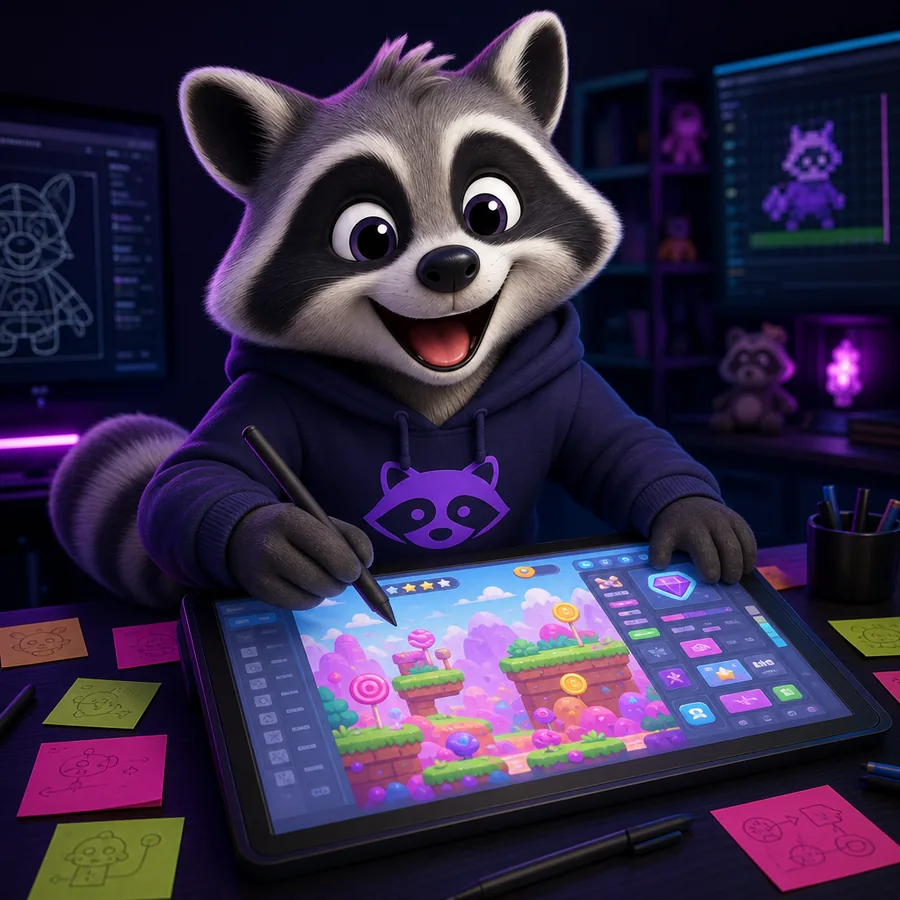

Kill bad ideas in hours, not sprints
Every studio has more game ideas than it has prototyping capacity. The expensive part isn't having the idea — it's the weeks of design, art and engineering it takes before anyone can look at a concept and say “yes, that” or “no, kill it”. So most ideas never get tested at all.
Vidscape compresses that whole loop into a working session. It studies your existing games — the art direction, the palette, the tone, the genre DNA — and asks you the questions a game designer would ask. Then it comes back with a slate of concept pitches. Pick the ones with a pulse, and each becomes a full design document with a planned asset list, on-style generated art and a high-fidelity visual mock of the game screen. The concepts that survive can be built into playable prototypes you can hand to anyone with a browser.
What you get from one link
Your art style, learned
Vidscape studies your published games and key art so every concept looks like it came from your studio — same palette, same energy, same visual grammar.
A design interview, not a form
A short conversation about audience, genre appetite and ambition shapes the pitches. You talk; it takes designer-grade notes.
A slate of concept pitches
Around ten distinct game concepts to react to — mechanics, hook, fantasy, mood. Greenlight the ones worth exploring, discard the rest.
Real design documents
Each greenlit concept gets a full design doc — gameplay, visual direction, UI layout, palette, fonts and a planned asset list. Every section is editable before anything is generated.
On-style art kits & visual mocks
Vidscape generates the concept's art — characters, backgrounds, UI pieces — and composes them into a polished, animated mock of the game screen.
Playable in the browser
One click hands the design doc and art to an AI developer that builds a real playable prototype. Share a link; anyone can play it — then refine it with plain-English instructions.
From pitch to playable
Concept, design, art and a prototype you can hand to anyone — all in your studio's style.


How AI game prototyping works
Paste your link
Your studio's site or one game's page. Vidscape learns your catalogue, art style and tone.
Talk it through
A short design interview about where you want the next game to go — audience, genre, ambition.
Pick your concepts
React to a slate of pitches. Each pick becomes an editable design doc, generated art and a visual mock.
Make it playable
Approve a mock and an AI developer builds a browser-playable prototype. Iterate with plain English.
What is AI game prototyping?
AI game prototyping is using AI to compress the earliest, most expensive phase of game development — concepting, design documentation, first art and a first playable — into hours instead of weeks. The goal isn't to ship the AI's output; it's to put something concrete in front of your team and stakeholders fast enough that greenlight decisions happen on evidence instead of imagination.
Vidscape's version starts from something no blank-page tool has: your actual games. Because every concept is grounded in your published catalogue and art direction, the prototypes read as plausible next titles from your studio — which is exactly what a pitch meeting needs.
What's the difference between the visual mock and the playable prototype?
The visual mock is a high-fidelity, animated picture of the game — the screen, the art, the UI, the mood — perfect for judging whether a concept looks and feels right. The playable prototype goes one step further: an AI developer takes the approved design document and art kit and builds a real game you can play in the browser, with actual mechanics.
You choose per concept. Some ideas die honourably at the mock stage for the cost of a coffee; the promising ones earn a playable build you can put in playtesters' hands the same day.
Claude is your game designer
The design documents and game mocks are written by Claude, Anthropic's frontier model — the same family of models professional studios use for creative and technical work. That's why the design docs read like a designer wrote them and the prototypes hold together as games, not slideware.
FAQ
Questions, answered.
Paste your studio's website or a game page into Vidscape. It learns your art style and catalogue, interviews you about the direction, then pitches ~10 game concepts. Pick your favourites and each becomes an editable design document, generated on-style art and an animated visual mock — with an optional one-click playable browser build.
Yes — that's the point. Vidscape analyses the art, palette and tone of your published games and uses your real key art as reference when generating new assets, so concepts look like plausible next titles from your studio rather than generic AI art.
The visual mock is a polished animated preview for judging look and feel. When a concept earns it, an AI developer builds a real playable prototype from the design doc and art kit — a working game that runs in any browser from a shareable link.
Everything pauses for you: you review the profile Vidscape learned, steer the design interview, choose which concepts advance, and edit every section of each design document — including the planned art list — before generation starts.
It doesn't replace one — it decides what your team should build. Instead of spending sprints discovering an idea doesn't work, you test a dozen directions in a day and give your developers the concepts that already survived a design doc, real art and a playable first pass.

Your next game is one link away.
Paste it. Pick a concept. Play the prototype.
powered by Claude · every pixel stays editable